
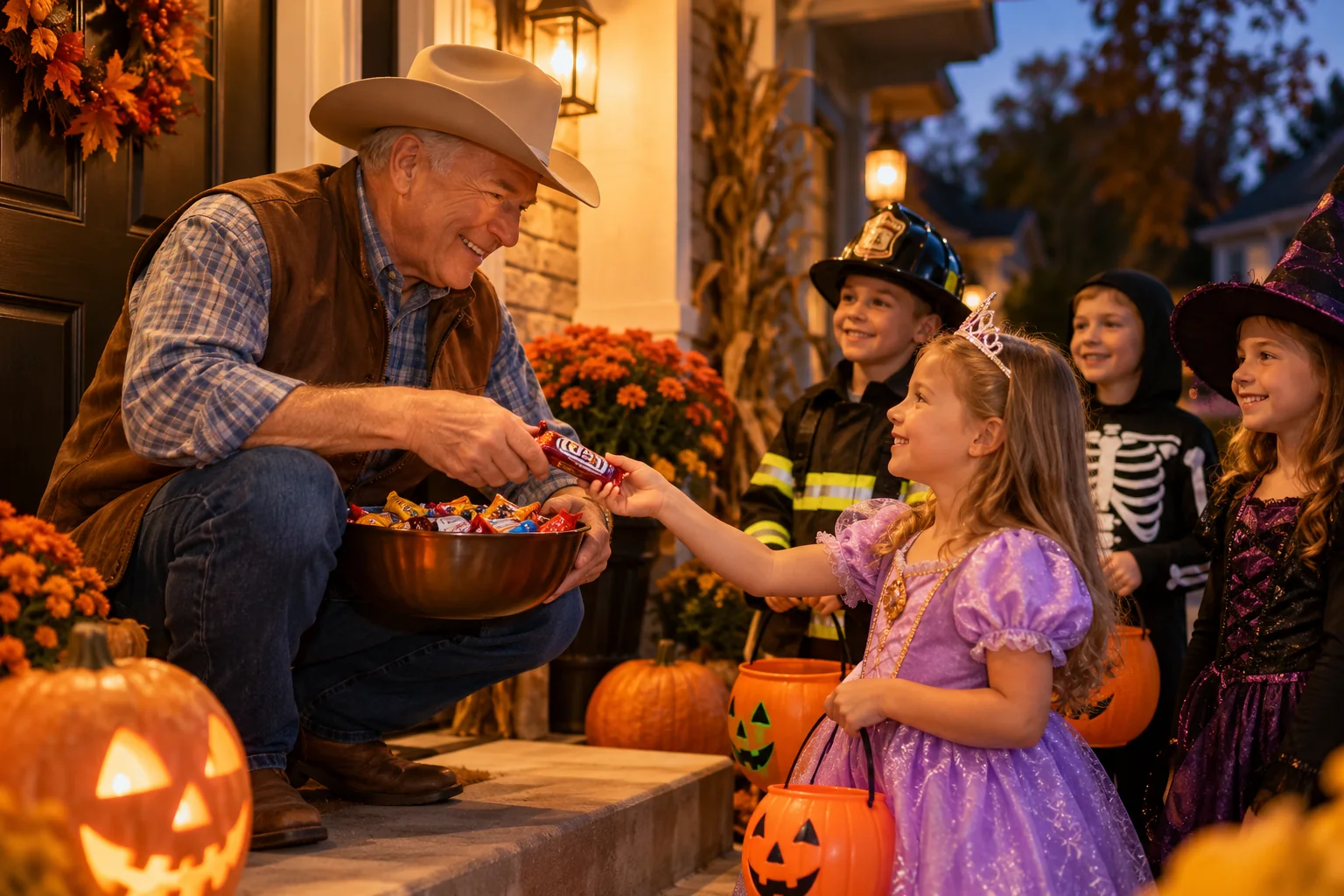
Y’all, every October, Christians seem to wind up on opposite sides of the same front porch.
One family is handing out candy. Another is keeping the lights off. Somebody is planning a church fall festival. And somebody else is wondering whether any of it belongs in a Christian home.
Those are fair questions. But before we let a holiday tell us what to believe, let’s open the Bible and ask what God actually says.
📖 1 Corinthians 10:31 (ESV)
“So, whether you eat or drink, or whatever you do, do all to the glory of God.”
That is a mighty useful starting point, and it is bigger than Halloween.
Where did Halloween come from?
Its history is more complicated than the slogans on either side. Some customs are associated with older Celtic seasonal observances, including Samhain. The name Halloween comes through All Hallows’ Eve, the evening before All Saints’ Day in the Christian calendar. Modern costumes, parties, and trick-or-treating developed through additional cultural changes over time.
So I would be careful about claiming every child who asks for a chocolate bar is secretly reenacting an ancient religious ritual. The historical evidence does not support that kind of blanket certainty. I would be just as careful about pretending every practice associated with the holiday is harmless.
The question isn’t just where a tradition came from. It’s what we’re doing with it, and whether it honors God.
What does God clearly forbid?
Here Scripture is not fuzzy. Deuteronomy 18:9–14 condemns divination, sorcery, and attempts to consult the dead. Leviticus 19:31 warns against mediums and spiritists. In Acts 19:18–19, people turning to Christ left their occult practices behind.
That means tarot readings, consulting psychics, spirit boards, attempts to contact the dead, occult rituals, and similar practices are not made spiritually safe by calling them entertainment. The same concern applies when those practices arrive through an app on your phone.
And if you have dabbled in something like that, the answer is not despair. Turn from it and turn to Christ. His mercy is greater than your past.
But Scripture does not explicitly say that a child wearing a firefighter costume, receiving candy, or greeting the neighbors on October 31 is practicing sorcery. We should not add a commandment God did not give.
Paul faced a surprisingly similar question
In 1 Corinthians 8–10, Paul dealt with Christians living in a culture where food could be associated with idol worship. He drew a real line between participating in idolatry and ordinary activity that might have a complicated cultural background.
Paul did not tell believers to ignore the danger of idols. He said to flee idolatry (1 Corinthians 10:14). But he also refused to turn every ordinary meal into a spiritual investigation. He considered conscience, the good of others, and the glory of God (1 Corinthians 10:23–33).
That does not settle every Halloween decision for us. It does give us a better way to think than either “everything is fine” or “everything is forbidden.”
But what about being separate from the world?
Christians are called to walk as children of light (Ephesians 5:8–11). We should not celebrate darkness, glamorize evil, or join practices that compete with our worship of God.
Deuteronomy 12:29–31 specifically warns Israel not to imitate pagan worship when worshiping the Lord. That is serious, but we should be precise about what the passage addresses rather than pretending it mentions every modern neighborhood custom.
And yes, the gray areas deserve thought. A witch costume, a horror movie, or a haunted house may raise different questions than a princess costume or a bowl of candy. Philippians 4:8 calls us to consider what is true, honorable, just, pure, lovely, and commendable. Ask what a choice celebrates, normalizes, or stirs up in your heart.
What if Christians disagree?
Romans 14 teaches us how to handle matters where faithful believers may reach different conclusions before God. One family may decide not to participate at all. Another may choose a church gathering. Another may hand out candy, enjoy harmless costumes, and use the evening to love its neighbors.
We do not have to pretend those choices are identical. We do need to resist looking down on a brother or sister who is sincerely trying to honor Christ.
Conscience matters. So does the responsibility to form that conscience under Scripture rather than fear, social pressure, or convenience.
Five questions for Christian families
- Does this involve actual occult practice? If so, the Bible gives a clear warning.
- Am I worshiping, approving, or celebrating something opposed to God? Do not excuse that as harmless fun.
- Is this pure and beneficial? Philippians 4:8 and 1 Corinthians 10:23 help us examine gray areas.
- Does this show love toward other people? Consider your children, neighbors, and fellow believers.
- Can I do this in faith and thank God for it? If your conscience says no, do not bulldoze it.
There is another opportunity we should not overlook
For some families, October 31 means staying home. For others, it means the one evening all year when the whole neighborhood comes to the front door.
There may be an opportunity there to be generous, kind, and genuinely welcoming. You do not need to turn every piece of candy into a sermon. Sometimes a friendly face and a little neighborly kindness are exactly what love looks like.
And if your family abstains, that can be a thoughtful act of faith too. The point is to follow Christ, not to win an argument about a calendar date.
So, is Halloween wrong for Christians?
Occult practice and idolatry are wrong. Scripture is clear about that.
Ordinary costumes, candy, and neighborhood visits are not specifically forbidden. Christians must still weigh their choices by Scripture, wisdom, conscience, and love.
That is not a convenient escape hatch. It is a call to take God’s Word seriously enough to say what it says, and not more than it says.
One thing to remember
The question isn’t just where a tradition came from. It’s what we’re doing with it, and whether it honors God.
One act for today
Before your family makes its October 31 plans, read 1 Corinthians 10:23–33 and Romans 14 together. Then talk through the five questions above without mocking families who decide differently.
A prayer
Father, give us the courage to reject what dishonors You, the wisdom not to add rules You have not given, and the love to treat our neighbors and fellow believers with grace. Help us do even ordinary things for Your glory. In Jesus’ name, amen.
Scripture and history notes: Read 1 Corinthians 8–10; Romans 14; Deuteronomy 18:9–14; Deuteronomy 12:29–31; Leviticus 19:31; Ephesians 5:8–11; Philippians 4:8; Acts 19:18–19. Historical context: Ronald Hutton, The Stations of the Sun (1996); “The Celtic New Year and Feast of the Dead,” Folklore 135(1) (2024), DOI 10.1080/0015587X.2023.2282282. Halloween has multiple historical influences; no single-origin story explains every modern practice.
Scripture quotation from the ESV® Bible (The Holy Bible, English Standard Version®), copyright © 2001 by Crossway, a publishing ministry of Good News Publishers. All rights reserved.