
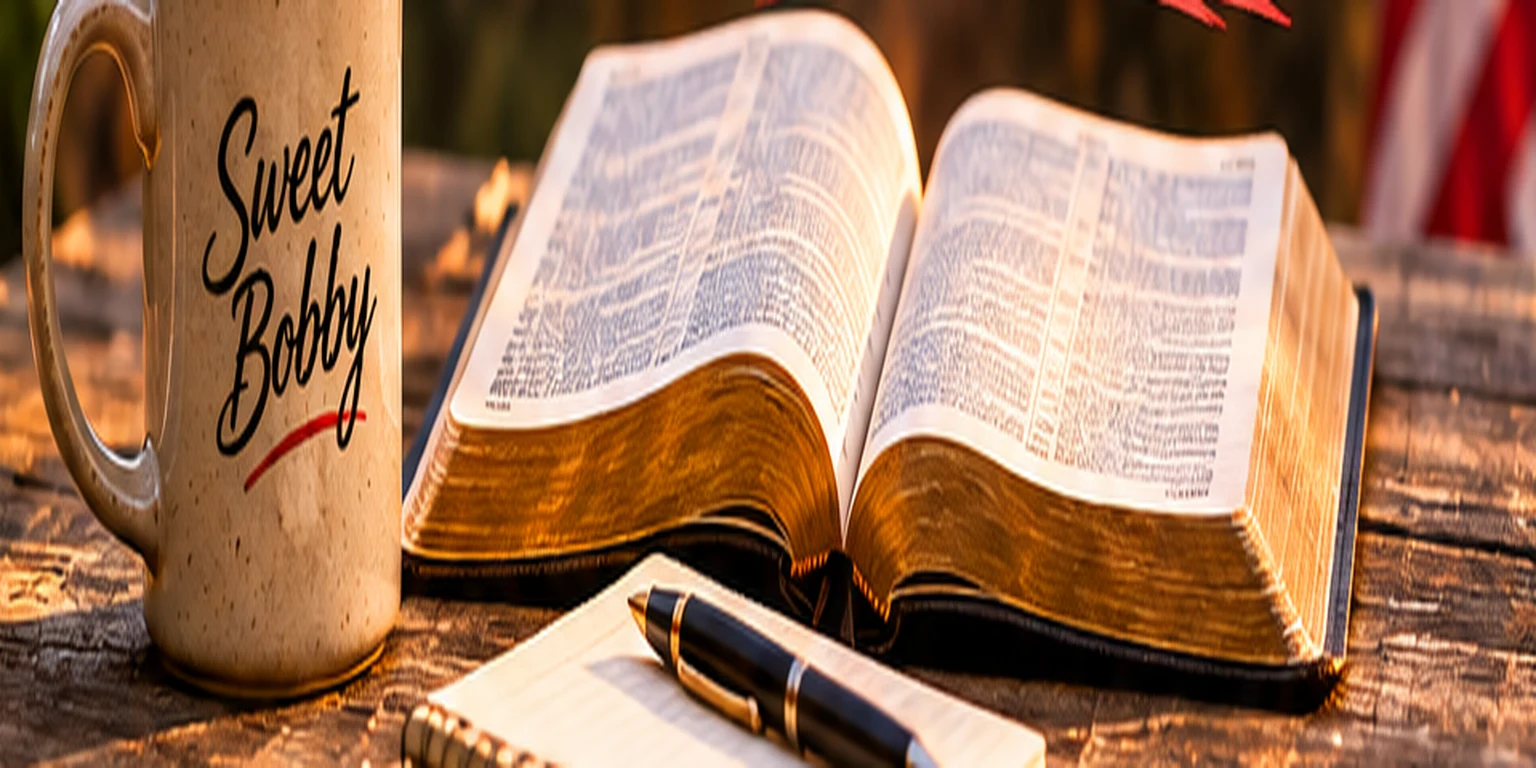
Lord, What If I Don't Like Either Candidate? 🤔
Sweet Bobby: In the Word
Pull up a chair, y'all. ☕ The coffee's on, and it's strong enough to stand a spoon in.
There's an election coming up, and I suspect some of you have been carrying a question around like a rock in your boot:
"Lord, what if I don't like either candidate?"
I'll confess, I've watched enough campaign ads to wonder how a body can spend so much time telling us what's wrong with everybody else and so little time telling us what he's actually going to do. 😂
But before we get carried away with their shortcomings, we ought to remember something. Every one of those candidates is a flawed human being. And so are we.
Romans 3:23 reminds us that all have sinned and fall short of the glory of God. That includes politicians, preachers, and the fellow at this kitchen table. Character still matters. But if we're waiting on a sinless candidate, we'll be waiting a mighty long time.
So what does a Christian do when none of the choices feels right? Let's open God's Word, because around this kitchen table, the Bible gets the final say. 📖
What Does the Bible Actually Command?
You won't find a verse that says, "Thou shalt vote in the November election." You won't find one that says Christians must stay out of elections, either.
Joseph, Daniel, Esther, and Nehemiah all served faithfully under rulers they didn't elect.
What Scripture does give us are clear commands about how to live.
First, we're commanded to pray for our leaders. Paul writes in 1 Timothy 2:1-2 that prayers and thanksgivings should be made for all people, including kings and all who are in high positions. He didn't say to pray only for the ones we like.
Second, we're commanded to respect governing authority. Romans 13:1 teaches that governing authority exists under God's sovereignty. Peter puts it this way:
"Honor everyone. Love the brotherhood. Fear God. Honor the emperor." 1 Peter 2:17, ESV
The emperor receives honor. God receives fear. And when earthly authority directly conflicts with God's command, the apostles drew the line:
"We must obey God rather than men." Acts 5:29, ESV
We respect government, but we worship God.
Third, we're called to care about the places God has put us. In Jeremiah 29:7, God told His people in exile to seek the welfare of the city and pray for it. They weren't voting in Babylon, but they were still to care for their neighbors.
Fourth, we remember where our highest loyalty belongs. When Jesus was asked about paying taxes, He said:
"Render to Caesar the things that are Caesar's, and to God the things that are God's." Matthew 22:21, ESV
Caesar's image was on the coin. God's image is on you.
Caesar gets the coin. God gets you.
Voting Is a Serious Matter
Just because Scripture doesn't give us a modern voting instruction doesn't mean our choices are unimportant. Proverbs 29:2 reminds us that righteous and wicked leadership both affect the people living under it.
We ought to remember, too, that the right to vote hasn't always been equally protected. On May 17, 1957, Dr. Martin Luther King Jr. stood at the Lincoln Memorial and pleaded, "Give us the ballot." Many Americans marched, went to jail, and even lost their lives to secure that right, and churches stood at the heart of that struggle.
In that same speech he said, "Both political parties have betrayed the cause of justice," and he described some leaders as having "a high blood pressure of words and an anemia of deeds." Sounds like he'd seen a few campaign ads himself.
Dr. King isn't our authority; Scripture is. But history ought to make us thoughtful before we wave off the responsibility of citizenship.
What If Both Candidates Are Flawed?
Well, friends, I can settle that part quickly. They are! But that doesn't mean every candidate is equally qualified, every policy equally wise, or every wrong worth overlooking. Exodus 18:21, written about choosing leaders to help Moses judge Israel, points to ability, reverence for God, trustworthiness, and integrity. It isn't a modern election guide, but it reminds us that character and competence both matter.
Here's where it gets hard. Some Christians look at two imperfect candidates and reason, "I'm not approving everything this person has done. I'm choosing the outcome I believe will do the most good or the least harm." Others look at the same choices and conclude, "I can't put my name behind either one in good conscience."
Some vote despite reservations, some write in a name, some leave one race blank, and some sit out entirely. Those choices don't all mean the same thing, and we don't know every person's reasons.
What About Christian Conscience?
Romans 14 matters here, but we need to read it carefully. Paul was settling disagreements about food and holy days, not elections, and that chapter is no blanket excuse to ignore real questions of justice. Still, he teaches us humility in how believers treat one another:
"Each one should be fully convinced in his own mind." Romans 14:5, ESV
Conscience isn't automatically right. It needs to be shaped and corrected by God's Word. But it shouldn't be bullied, either. Our Baptist Faith and Message says it plainly: "God alone is Lord of the conscience." When we're uncertain, we go back to the Bible and to prayer.
Is a Vote the Same as an Endorsement?
Christians don't all answer that the same way. Some see a vote as a practical choice about who will govern, not a declaration that the candidate is a fine person. Others believe supporting a particular candidate would signal approval they can't give.
For context, the U.S. Catholic bishops address a narrower situation: when all candidates promote an intrinsically evil act, their guidance discusses either declining to vote for any candidate in that race or, after careful moral reasoning, choosing the candidate less likely to advance that evil. That is their church’s moral guidance, not a blanket rule for every disappointing election. Our final authority remains Scripture.
Either way, Scripture gives us a warning: don't start excusing sin because it's committed by somebody on your side.
Mercy, we can get good at that, can't we? Our fellow does something wrong, and suddenly we're his defense attorneys. The other side does the very same thing, and we want to throw the book at him. Wrong doesn't become right because our favorite did it.
"To do justice, and to love kindness, and to walk humbly with your God." Micah 6:8, ESV
Justice doesn't change depending on who's in office. Neither does truth.
What If I Decide Not to Vote?
Here we need to be careful about judging one another. Some believers may decide abstaining from a particular race is the most faithful choice they can make. Others believe taking part, even with imperfect choices, is part of loving their neighbors.
James 4:17 says knowing the right thing and failing to do it is sin. James wasn't writing about elections, and that verse won't tell you whether to vote in a particular contest. But it ought to make us check our motives. Have I prayed, studied, and reached a conviction? Or am I just tired of the whole mess? There's a difference between a considered conviction and throwing up our hands.
Don't Let an Election Divide the Family of God ❤️
Here's what troubles me more than any election result: Christians treating one another like enemies over political conclusions.
Two believers can pray together and still disagree about an election. That deserves honest talk, but disagreement is no excuse for contempt. Romans 14:10 asks why we despise a brother or sister when we will all stand before God.
Jesus said in John 13:35 that the world would know His disciples by their love for one another. Not by yard signs. Not by bumper stickers. Not by whom we defended on Facebook last night. By love.
Jesus Is Still King 👑
Elections matter. Leadership matters. Justice matters. Our neighbors matter. But elections are not ultimate.
Philippians 3:20 reminds us that our citizenship is in heaven, and from it we await a Savior, the Lord Jesus Christ.
Jesus isn't running for office. He doesn't need donations or a consultant to explain away something He said yesterday. He didn't need a campaign to become King. He went to the cross for our sins, rose from an empty tomb, and reigns forever.
So here are three questions to carry to your own kitchen table:
- Have I prayed and asked what Scripture actually requires of me?
- Am I being consistent about character, justice, and truth, no matter whose side it's on?
- Can I love a fellow Christian who reaches a different conclusion?
And one thing to do this week: pray by name for one leader you didn't vote for, or wouldn't.
I can't tell you every Christian must mark a particular name or leave it blank. But I can tell you this:
Whatever you decide about the ballot, don't let the ballot decide who you belong to.
We belong to Jesus. When the election is over, the coffee will still be brewing, our neighbors will still need loving, our leaders will still need praying for, and our King will still be on His throne. That's one election result we never have to worry about. ❤️
Let's Pray 🙏
Heavenly Father, thank You that Your truth doesn't change with elections, parties, or the opinions of men. Forgive us when we put too much faith in earthly leaders or let political disagreements crowd out our love for one another.
Give us wisdom, courage, humility, and grace toward those who see things differently.
Lord, whoever holds public office, help us pray for them, speak truthfully about them, and keep our ultimate hope in Jesus Christ, who died and rose again and reigns forever.
In His precious name, Amen.
Scripture quotations are from the ESV® Bible (The Holy Bible, English Standard Version®), © 2001 by Crossway, a publishing ministry of Good News Publishers. Used by permission. All rights reserved.
Context and further reading: 1 Timothy 2:1-2; Romans 13:1; Jeremiah 29:7; Romans 14; James 4:17; Philippians 3:20; Micah 6:8. Martin Luther King Jr., “Give Us the Ballot,” May 17, 1957. The Baptist Faith and Message, Article XVII. Historical context and church statements do not replace Scripture.